
Hiring Your First Employee: A Payroll Checklist
Bringing on your first employee involves more than agreeing on a salary. Here is what actually has to be in place before their first payslip.

Hiring your first employee is a genuine milestone — and also the moment your business takes on obligations it did not have before. Agreeing on a salary is the easy part. Here is the checklist of what actually has to be in place before that first payslip goes out.
1. Register as an employer
Before you can contribute EPF, SOCSO, or EIS on an employee's behalf, your business needs to be registered as an employer with KWSP (kwsp.gov.my) and PERKESO (perkeso.gov.my, which also covers EIS registration). This is a one-time setup step, and it needs to happen before the first payroll run, not after.
2. Get an employment contract in writing
Salary, working hours, probation period, and notice period should all be documented, not just discussed verbally. It protects both sides and gives you a clear reference point if a dispute ever comes up later.

3. Understand the four statutory deductions
EPF (retirement savings), SOCSO (workplace injury and invalidity coverage), EIS (unemployment insurance), and PCB (monthly income tax) all apply from the first payslip. Each has its own contribution rate and, for PCB, its own calculation based on the employee's estimated annual income.
Employer EPF and SOCSO/EIS contributions are a cost to your business on top of the employee's salary, not deducted from it — budget for the true cost of hiring, not just the take-home figure you agreed on.
4. Issue an itemised payslip, every time
Under the Employment Act 1955, employers must provide itemised payslips showing wages, allowances, and every individual deduction. It does not need to follow a specific government-mandated format, but it does need to be complete and clear.
The bottom line
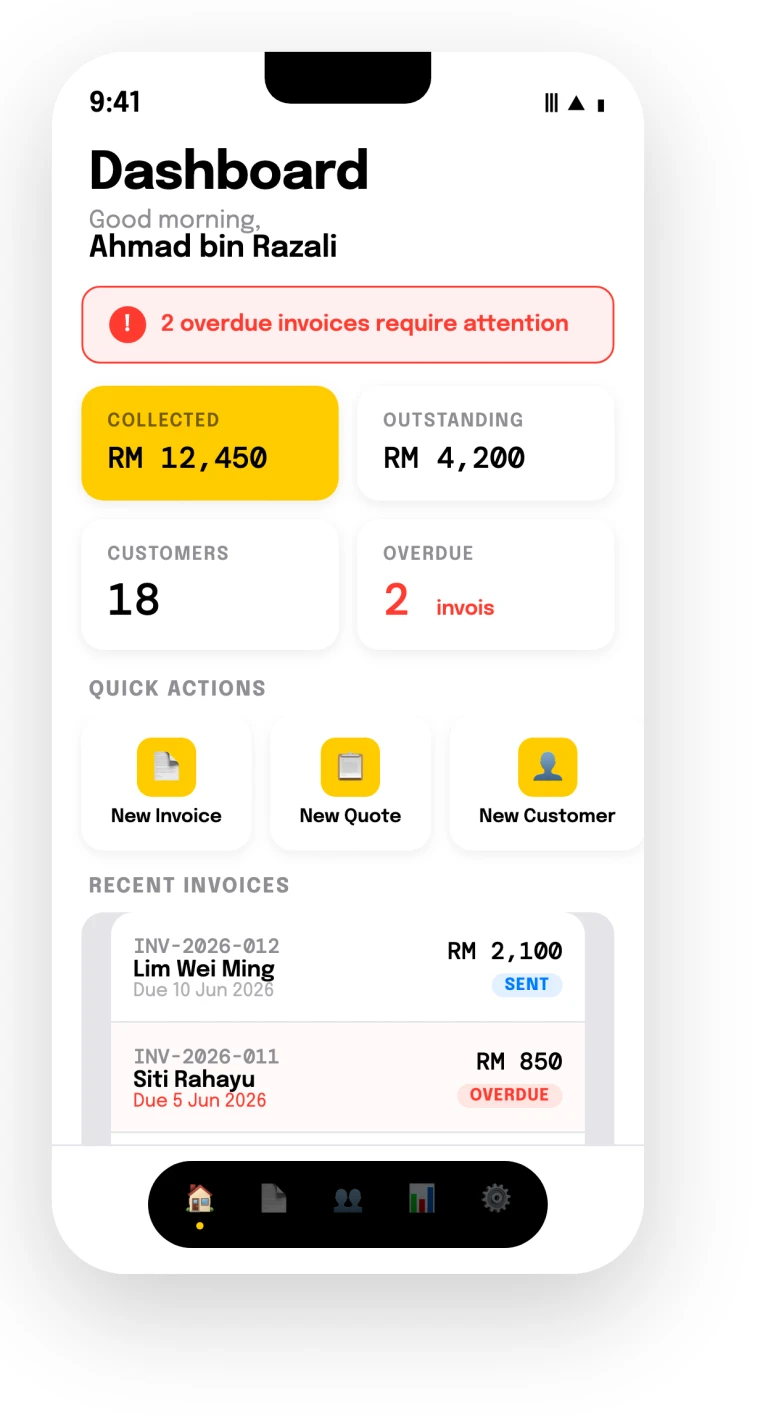
Hiring your first employee is a good problem to have. Get the registration and paperwork sorted before day one, and payroll becomes routine instead of something you dread every month. Faktur.my calculates every statutory deduction on the current rates automatically, so your first payslip is as accurate as your hundredth.
FAQ
What do I need to register for before hiring my first employee in Malaysia?
You need to register as an employer with EPF (KWSP) and SOCSO (which also covers EIS registration), so you can make statutory contributions on your employee's behalf from their very first payslip.
Do employer EPF and SOCSO contributions come out of the employee's salary?
No. The employer's portion of EPF, SOCSO, and EIS is a separate cost on top of the salary you agreed to pay — only the employee's own contribution reduces their take-home pay.
Is a written employment contract legally required in Malaysia?
While not every employment arrangement strictly requires a written contract, having one in writing — covering salary, hours, probation, and notice period — is strongly recommended and protects both employer and employee if a dispute arises.
What must be included on a Malaysian payslip?
Under the Employment Act 1955, an itemised payslip must show gross wages, hours worked (including overtime), and the nature and amount of every individual deduction — including EPF, SOCSO, EIS, and PCB.
Try it for yourself
Invoices, quotes, payslips, and statements — built for Malaysian businesses. Free to download.